Why Airships Never Replaced Ocean Liners?
The Promise Was Real
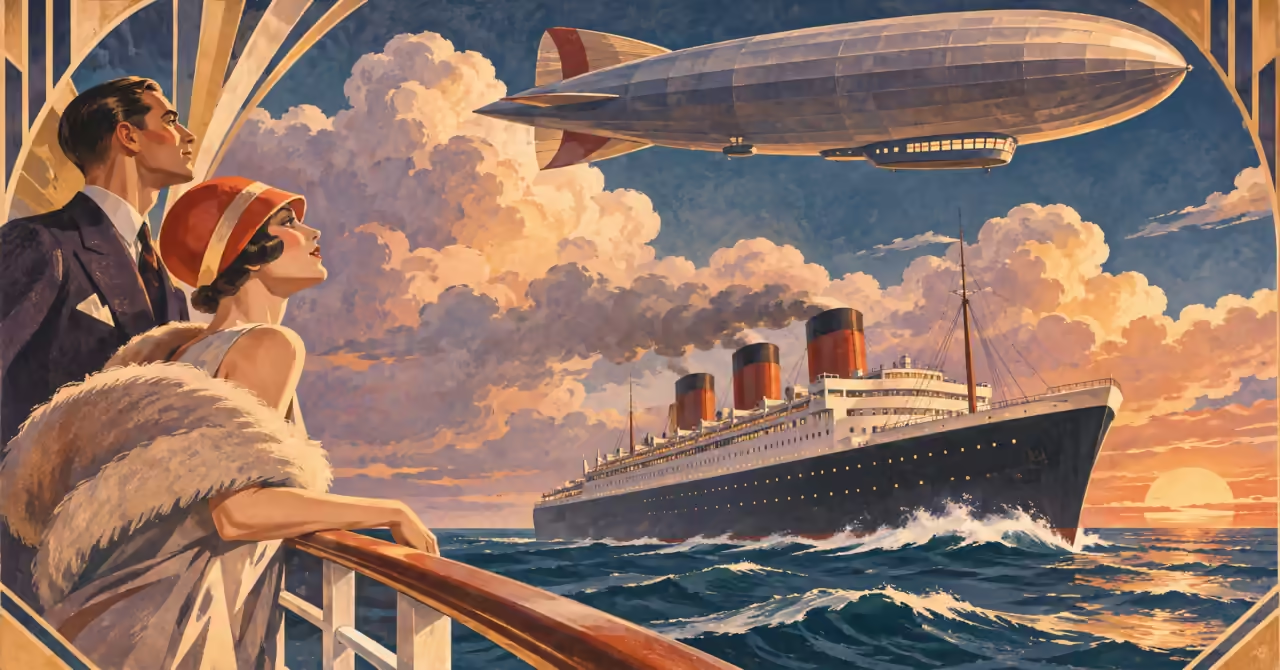
For a brief period in the 1930s, the prospect of airships challenging ocean liners was far from absurd. During its 1936 North Atlantic service, the Hindenburg averaged 63 hours and 42 minutes westbound from Frankfurt to Lakehurst, and 51 hours and 46 minutes on the return journey. The fastest ocean liners typically required around four to five days for their passages. The airship therefore offered a substantial saving in time, although its advantage was less dramatic than a simple comparison of two days against five might suggest. With a cruising speed of approximately 76 miles per hour and accommodation for 50 passengers in its original configuration, the Hindenburg was a genuine commercial transport proposition, not merely a technological spectacle.
That is why the question keeps returning. If an airship was faster, could travel high above the sea, and offered a luxurious ride, why did it not take over the Atlantic from the liner
The answer is less romantic than the premise. Speed was only one variable. A transport system has to move people reliably, in quantity, through ordinary weather from ordinary places, day after day, at a cost that can survive the books. Airships could win on prestige and crossing time. They lost on throughput, infrastructure, reliability, and the sheer business of running a route.
Capacity Was the Real Contest
The ocean liner’s advantage was scale. By the 1930s, the great North Atlantic liners could carry thousands of passengers and crew, along with substantial stores and fuel. The Queen Mary’s crossings are commonly given at around five days, and the Mauretania had already carried more than 2,000 passengers on a single voyage decades earlier. These were not merely ships that happened to be large. They were floating systems built to sell many berths on every crossing.
A rigid airship was large in a different sense. The Hindenburg’s 200,000 cubic metres of lifting gas and its long hull made it visually overwhelming, but its paying load was tiny by comparison. Even when it was operating as intended, it remained a niche vehicle. In one season it made 55 flights and carried 2,798 passengers in total. That is a respectable figure for a prestige service, but it is not remotely the capacity of an ocean liner.
This is the first hard reason the airship never displaced the ship. A liner could spread its costs across a vast number of tickets. An airship had to earn its keep one small cabin at a time. Its grandeur was real, but grandeur does not substitute for volume when the business depends on filling a schedule.
Reliability Was the Harder Problem
The airship’s great promise was that it could fly above the sea rather than fight through it. In practice, that did not mean weather became irrelevant. It meant the weather problem changed shape. Wind, gusts, turbulence, and the handling of a vast lightweight structure near the ground all mattered, and they mattered in ways far more awkward than the weather faced by a ship.
A rigid airship had to be light enough to rise, yet strong enough not to buckle under dynamic loads. That is a narrow engineering corridor. Save weight and you preserve lift, but you also reduce margin against gusts, landing stress, and the strain of managing a vehicle that is enormous, flexible in some directions, and delicate in others. A ship can be heavy and still float. An airship must keep its weight under control at every stage of the voyage.
Ocean liners had weather problems too, but they were built to absorb punishment. They could be made heavy, reinforced, and stable enough to continue in conditions that would keep an airship grounded. The sea was hostile, but it was a hostile medium the liner understood. The airship was trying to inhabit a narrower, more exacting zone between too light and too fragile.
There is a deeper point here than meteorology. People did not buy transatlantic travel only as motion across space. They bought predictability. The liner sold a timetable that, while vulnerable to weather, was still governed by an industrial rhythm. The airship sold a more fragile promise: faster when conditions cooperated, but harder to guarantee when they did not. Reliability is not a side benefit in transport. It is part of the product.
The Ground System Mattered
Airships also had a problem that is easy to forget because it sits outside the glamour of flight. Every journey began and ended with ground handling, and ground handling was where the elegance often disappeared. Airships needed mooring masts, support crews, and careful procedures for docking, ballasting, and dispatching the ship. Bringing one under control in windy conditions was not like taxiing an aeroplane to a gate. It was more like coordinating a huge buoyant structure with a trained crew on the ground and a great deal of nerve.
That made airships infrastructure tourists. They did not simply use the existing transport world; they needed a new logistics geography. Hangars, mooring fields, training, maintenance routines, and specialised crews all had to be provided in the right places. The system could be built, but it was expensive and thinly distributed. A route network is not just a line on a map. It is the sum of the places where a vehicle can safely arrive, be handled, be serviced, and be sent on again.
Ocean liners already had that world. Harbours, docks, cranes, coal supplies at first and later oil bunkering, customs facilities, port labour, and established terminal cities were already in place on both sides of the Atlantic. The liner did not need a new geography to exist. It used the one that was already there.
That difference also affected the total journey. Enthusiasts sometimes treated the crossing itself as the whole trip, but passengers still had to travel from an airfield or mooring ground to their actual destination. Once those terminal legs were included, the apparent two-day passage could become something closer to a three-day door-to-door journey. That was still quick, but it narrowed the advantage over the best liners more than the headline crossing time suggests.
Economics Favoured the Established Route
The reason the liner survived is not that it was more elegant. It is that it was more economical at scale. The great ships of the Atlantic were expensive, but they were fundamentally built to carry many people. Their cost could be distributed across a large hull full of berths, public rooms, cargo, and crew. The liner literature of the period shows shipbuilders pushing in a familiar direction: higher speeds, better stabilisation, larger hulls, shorter crossings. They were not trying to imitate the airship. They were trying to make the ship a better ship.
The airship had little room for a comparable improvement curve. Its lifting gas imposed constraints on payload and range. Its structure had to remain extraordinarily light. Its handling required crews and facilities that were expensive in themselves. And because the airship could not carry liner-scale numbers of passengers, every fixed cost pressed harder. Prestige was not enough to offset that arithmetic.
There was also a competitive issue that emerged quickly. Once aviation improved, the airship no longer held a monopoly on speed. Airplanes would soon eclipse it on time and frequency, while ships retained their own advantages in comfort, stability, and volume. The airship was stuck in an awkward middle: too limited to match the liner’s economics, too slow to beat the airplane’s future, and too dependent on a specialised support system to become routine.
That is why the better question is not whether the airship was technologically impressive. It obviously was. The question is why an impressive machine failed to become a dominant system. The answer is that transport is a contest between entire operating worlds, not between isolated vehicles.
Trust Broke First
The Hindenburg’s story made the final break impossible to ignore. Its safety case depended on a lifting gas choice that was as political as it was technical. The ship used hydrogen because helium was unavailable to Germany; U.S. export restrictions prevented conversion to the safer gas. After the disaster at Lakehurst was filmed and broadcast, the commercial passenger airship lost public confidence almost overnight.
That did not merely damage a brand. It exposed how thin the margin of trust already was. A transport mode can survive technical difficulty for a long time if passengers believe it is governable. It cannot easily survive a catastrophe that makes control look contingent and improvisational. Once people decide that one bad day can collapse the whole experience, the elegance of the machine stops mattering very much.
Here the liner had one more advantage: it felt governable in the ordinary sense. It was slower, but it was legible. Ports, schedules, crews, and weather delays were part of a known world. Airships were newer, rarer, and more vulnerable to the perception that every trip depended on conditions outside the operator’s control.
So the airship did not fail because it had no uses. It failed because its uses were narrow, its infrastructure was demanding, its throughput was small, and its reliability was too contingent for mass travel. It was excellent at a set of things the liner was never trying to do. But replacing the liner would have required all the virtues at once: speed, scale, safety, infrastructure efficiency, and public confidence. The airship could not assemble that package.
The liner was slower, but it was a transport system. The airship was beautiful, but it remained an experiment in what happens when you try to make the sky behave like a harbour.
Author's Notes
Notes & Memoranda
As is often the case, the subject extends beyond the bounds of a single article. The notes and memoranda below gather together useful definitions, related observations, references, and occasional curiosities discovered along the way.
Glossary
- Rigid airship
- An airship whose overall form is maintained by a lightweight internal structure rather than by gas pressure alone.
- Throughput
- The quantity of passengers, freight or other traffic a transport system can move through a route over time.
- Ground handling
- The people, procedures and equipment required to bring an airship under control near the ground, moor it, service it and dispatch it again.
- Mooring mast
- A fixed structure used to secure and manage an airship while it is on the ground.
- Lifting gas
- A gas lighter than the surrounding atmosphere that provides the buoyant lift needed to support an airship.
Frequently asked questions
These questions summarise the central comparison made in the article.
Why didn't airships replace ocean liners?
The article argues that speed alone was not enough. Airships faced disadvantages in passenger capacity, ground infrastructure, weather sensitivity, operating economics and public confidence.
Were airships faster than ocean liners across the Atlantic?
The article describes rigid airships as capable of much shorter crossing times, while arguing that the advantage narrowed when capacity, terminal access and operational reliability were considered.
Why did ground infrastructure matter so much?
Airships required specialised mooring, handling, maintenance and trained crews. Ocean liners operated through an already established network of ports and supporting services.
What role did the Hindenburg disaster play?
The article treats the disaster as a major break in public confidence, adding a trust problem to the mode's existing operational and economic disadvantages.
Further Reading…



References and Further Reading
- National Air and Space Museum, Smithsonian, “Are We in an Airship Renaissance?” https://www.smithsonianmag.com/blogs/air-space-museum/2024/01/02/airship-renaissance/
- National Air and Space Museum, Smithsonian, “Following the Hindenburg.” https://airandspace.si.edu/stories/editorial/following-hindenburg
- U.S. Library of Congress, Report of the Librarian of Congress, 1937, Division of Aeronautics. https://tile.loc.gov/storage-services/service/gdc/scd0002/0007/00072432551/00072432551.pdf
- “The Transatlantic Liner of the Future,” Journal of the Institution of Naval Architects (1937), digitised by IMarEST. https://library.imarest.org/record/1653/files/1680.pdf
- National Air and Space Museum, Smithsonian, “The Hindenburg.” https://airandspace.si.edu/stories/editorial/following-hindenburg
- National Museum of American History, Smithsonian, ocean liner and transatlantic crossing collections material. https://americanhistory.si.edu/
Disclosure
This article is an interpretive comparison of historical transport systems. Quantitative performance figures, operating claims and historical causal statements will be checked against the cited sources during the final pre-publication review. No factual verification has been performed as part of this Chronos migration.